 English
 русский
 Español

Heavy-Duty Angle Grinder with Permanent Laser-Engraved Branding for Professional Work
Introduction
Angle grinders are among the most versatile power tools used in metal fabrication, construction, maintenance, repair, and industrial workshops. A dependable grinder must deliver more than a high power rating. It must maintain stable performance under load, transfer power efficiently, withstand heat generated during prolonged operation, and remain serviceable after repeated grinding and cutting tasks. For professional users, durability, consistency, identification, and total operating value are often more important than a single headline specification.
The SW9600 angle grinder is designed around these practical requirements. It combines a 1150W motor system with reinforced internal electrical components, double tight-fit gears, an enlarged commutator, extended carbon brushes, and an integrated head shell and gear housing. It also uses laser-engraved branding on the tool body, providing a permanent identification method for professional tool owners, contractors, rental fleets, and businesses purchasing equipment for distribution or private-label programs.
With a rated voltage of 220–240V and a frequency range of 50/60Hz, the grinder is suitable for many standard commercial and workshop power environments. Its 100 mm blade size supports a broad range of grinding, cutting, rust removal, weld finishing, and surface preparation tasks. The compact format allows operators to work in areas where larger grinders may be less convenient, while the reinforced construction is intended to support demanding applications.
This article examines the product’s operating concept, internal construction, manufacturing strengths, professional advantages, application suitability, maintenance requirements, and value for buyers comparing it with conventional angle grinders.

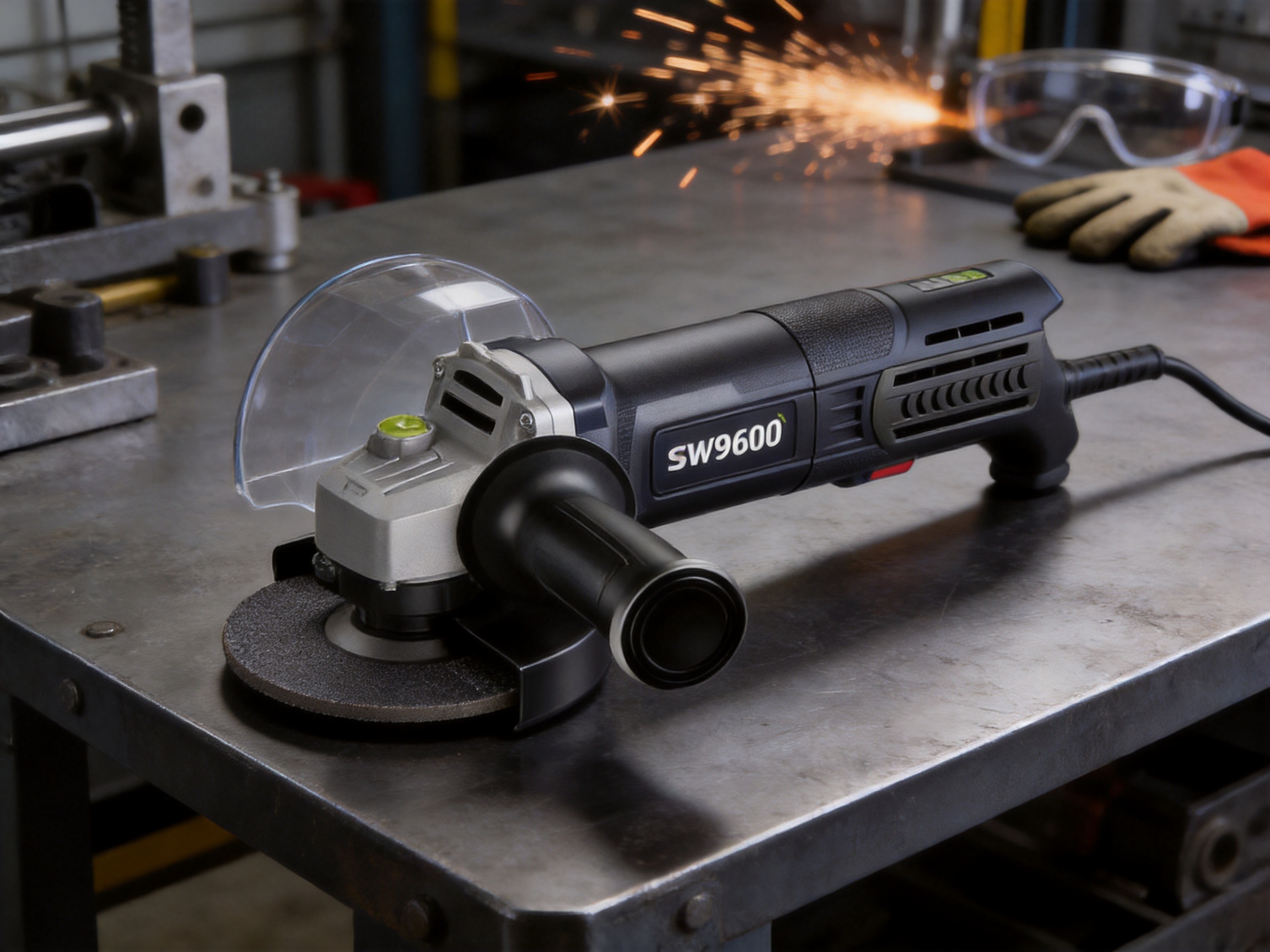
SW9600 Angle Grinder with Laserengraving Logo
Product Overview
The SW9600 is a corded angle grinder developed for users who need reliable power in a compact and manageable format. Its 1150W input rating provides a strong foundation for general metalworking and construction applications. The grinder can be used for tasks such as cutting metal, removing surface rust, smoothing welds, preparing edges, cleaning fabrication components, and performing general workshop maintenance.
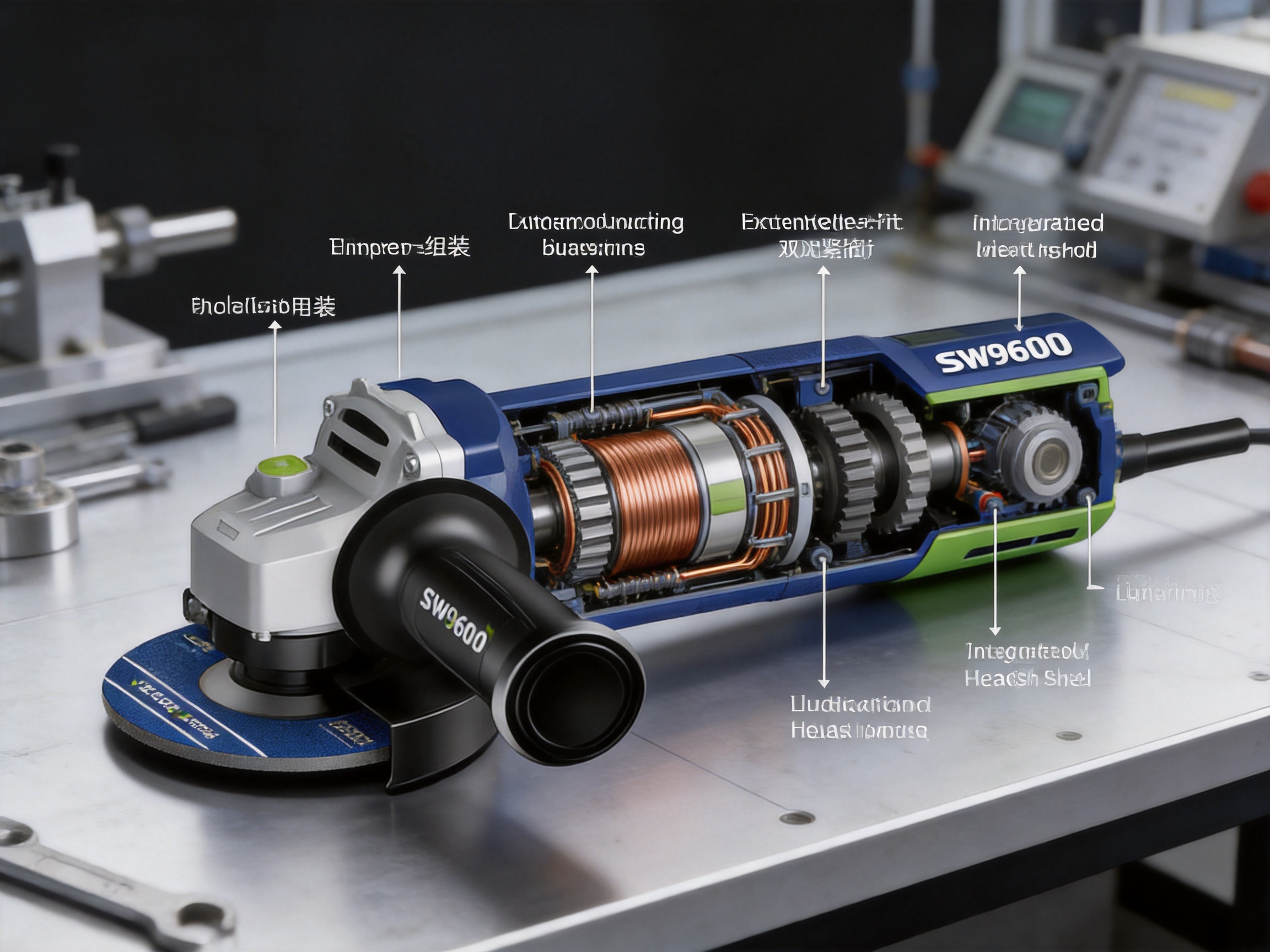
The product is distinguished by the way its electrical and mechanical systems are reinforced. A 200°C high-temperature copper wire system is paired with a 63H motor design to support stronger overload capacity. The enlarged and heightened 24.5 mm commutator is intended to improve electrical contact between the rotor and carbon brushes. The extended 6 × 11 mm carbon brushes help support longer service intervals compared with smaller brush arrangements commonly found in basic tools.
The mechanical transmission system uses double tight-fit gears. Proper gear engagement is essential in an angle grinder because the motor’s rotational energy must be transferred to the spindle with minimal unnecessary movement. Tight-fitting gears can contribute to smooth transmission, reduced backlash, and more consistent operation when the tool is exposed to resistance from a workpiece.
The grinder also features a head shell integrated with the gear housing. This design approach reduces the number of separate structural interfaces around the front of the tool. A more unified head construction can help support rigidity and improve protection for the gear assembly during regular use.
Another important feature is the laser-engraved logo on the body. Unlike adhesive labels or surface printing, laser engraving creates a permanent mark in the housing surface. This is especially valuable for distributors and professional users who need tool identification to remain visible despite handling, dust, vibration, and repeated cleaning.
Key Technical Specifications
| Specification | Product Information |
|---|---|
| Product model | SW9600 |
| Product type | Angle grinder |
| Rated voltage | 220–240V~ |
| Rated frequency | 50/60Hz |
| Power input | 1150W |
| Blade size | 100 mm |
| Stator specification | Ø53 × 63H |
| Rotor specification | Ø32 × 63H |
| Commutator | 24.5 mm enlarged and heightened design |
| Carbon brushes | 6 × 11 mm extended design |
| Motor wire | 200°C high-temperature copper wire |
| Gear construction | Double tight-fit gears |
| Brand identification | Laser engraving on the tool body |
The specifications show that the SW9600 is positioned as a professional-oriented compact grinder rather than a light-duty hobby tool. The 1150W power input is appropriate for a wide range of grinding and cutting operations, while the 100 mm blade format supports control and accessibility. The electrical dimensions and reinforced motor components are intended to help the grinder retain performance during repeated work.
Permanent Laser-Engraved Branding
Why Branding Matters on Professional Tools
Brand identification is often treated as a cosmetic detail, but it can have practical importance in professional environments. Contractors, workshops, rental companies, and industrial maintenance teams may own dozens or hundreds of similar-looking tools. Clear identification helps users recognize assigned equipment, manage inventory, reduce confusion between departments, and maintain accountability for tools issued to workers or job sites.
Temporary labels and adhesive stickers can peel, tear, fade, or become difficult to read after exposure to dust, oil, abrasion, and repeated handling. Printed markings may also wear away as the tool is transported in cases or placed on rough work surfaces. Laser engraving addresses these limitations by creating a permanent mark that remains part of the tool housing.
Advantages of Laser Engraving
The laser-engraved logo on the SW9600 is designed to remain visible throughout the working life of the grinder. It does not rely on glue, ink, or a separate label layer. This makes it suitable for companies that want a consistent identity across their tool fleet or for buyers ordering products with a dedicated business logo.
Laser engraving can also improve the appearance of a tool over time. A grinder that retains its identification looks more professional when used at customer sites, construction projects, workshops, and service locations. For distributors, a permanent logo may help strengthen product recognition and reduce the need for replacement labels during storage and resale.
Compared with conventional sticker-based branding, the engraved marking is less vulnerable to peeling caused by heat, vibration, or contact with work gloves. It is also less likely to be removed accidentally during routine cleaning. These characteristics provide a useful advantage for buyers who view branding as part of long-term equipment management rather than simple decoration.
Motor and Electrical Construction
200°C High-Temperature Copper Wire
Heat is one of the main challenges faced by corded power tools. During grinding and cutting, the motor may operate under substantial resistance. Electrical current flowing through the windings generates heat, and the surrounding components must tolerate that temperature without rapid deterioration.
The SW9600 uses copper wire rated for high-temperature operation up to 200°C. This design choice supports the motor’s ability to handle demanding working conditions. High-temperature wire insulation is particularly relevant for professional users who may operate the grinder repeatedly throughout the day, with only short pauses between tasks.
The use of copper conductors also supports efficient electrical transmission within the motor. While the complete performance of a motor depends on many factors, including winding design, rotor balance, ventilation, commutator quality, and manufacturing accuracy, durable copper wire provides an important foundation for reliable operation.
63H Motor Design
The 63H motor specification is part of the grinder’s reinforced power system. It is designed to provide strong overload capacity for demanding applications. Overload capacity does not mean that the tool should be intentionally forced beyond its operating limits. Instead, it indicates that the motor system is engineered to tolerate temporary increases in working resistance more effectively than a lightly constructed unit.
In practical use, the motor may encounter changing material thickness, hard spots in welds, uneven surfaces, or momentary pressure from the operator. A robust motor design helps reduce the likelihood of immediate power loss when these conditions occur. It also contributes to a more stable working experience when the grinder is used for repetitive metal preparation and cutting operations.
Enlarged and Heightened Commutator
The 24.5 mm enlarged and heightened commutator is one of the most important internal features of the SW9600. The commutator works with the carbon brushes to transfer electrical current to the rotating armature. Consistent contact is essential for stable motor operation.
A larger commutator provides a broader contact structure for the brushes. The heightened design also supports the electrical interface as the brushes move across the commutator surface. When manufactured and assembled accurately, this arrangement can contribute to improved current transfer, reduced instability, and better resistance to the stresses associated with repeated use.
Basic angle grinders may use smaller or less reinforced commutator arrangements to reduce production cost. Such designs can be suitable for occasional light work, but professional applications often require stronger internal components. The enlarged commutator of the SW9600 reflects a focus on working life and consistent electrical performance.
Extended Carbon Brushes
The grinder uses 6 × 11 mm extended carbon brushes. Carbon brushes are wear components, meaning that they gradually shorten as the tool operates. Their dimensions and material quality influence service intervals, electrical contact, and ease of maintenance.
Extended brushes can provide more usable wear material before replacement becomes necessary. This is beneficial for users who operate grinders regularly and want to reduce interruptions. Longer service intervals can also lower maintenance frequency across a large fleet of tools.
Brushes should still be inspected according to the working environment and usage intensity. Dust from abrasive materials may enter the tool, and prolonged operation can accelerate wear. The extended design does not eliminate maintenance, but it can provide a practical advantage over smaller brush systems commonly used in low-cost grinders.
Mechanical Transmission and Gear Durability
Double Tight-Fit Gears
The gear assembly determines how effectively motor speed and torque are transferred to the spindle. In an angle grinder, the gears must operate at high rotational speed while managing resistance from the mounted disc. Any excessive clearance, poor alignment, or insufficient lubrication can lead to noise, vibration, heat, and premature wear.
The SW9600 uses double tight-fit gears to support smooth and reliable power transmission. Tight engagement helps reduce unwanted movement between the gear teeth. It can also improve the feeling of control when the disc contacts the workpiece, especially during edge grinding or weld smoothing.
Gear accuracy depends on more than the basic concept of tight fit. It requires suitable materials, consistent tooth formation, correct alignment, controlled assembly tolerances, and appropriate lubrication. The manufacturing process therefore plays a central role in determining whether the gear design delivers its intended benefit.
Integrated Head Shell and Gear Housing
The head shell and gear housing are integrated into a unified structural arrangement. The front section of an angle grinder experiences vibration, impact, and heat, so it must provide stable support for the spindle and gears.
An integrated housing can improve structural continuity around the gear chamber. Fewer separate interfaces may help limit movement between components and provide a more rigid foundation for the transmission system. This design is also useful for protecting the internal gears from accidental contact and general job-site exposure.
For professional users, durability is not limited to motor life. The housing, gear chamber, spindle support, switch system, power cord, and brush system all contribute to the total service life of the grinder. The SW9600’s front-end construction reflects an effort to reinforce the areas most directly involved in power delivery.
Manufacturing Processes and Quality Strengths
Integrated Research, Production, and Sales
The manufacturer is an integrated power tool company with capabilities covering research and development, production, and sales. This integrated structure can provide advantages over businesses that depend entirely on disconnected external suppliers for product design, assembly, and after-sales coordination.
When engineering and production teams work closely together, product details can be reviewed from both performance and manufacturability perspectives. Design decisions such as commutator size, brush dimensions, gear engagement, motor winding, and housing construction can be evaluated as part of a complete system rather than as isolated components.
Integration also supports more direct communication with customers. Feedback from professional users, distributors, and project buyers can be transferred to product development and manufacturing teams more efficiently. This is valuable in markets where tools must adapt to different job-site conditions, regional electrical standards, usage habits, and private-label requirements.
Material Selection
Material selection is a major factor in the quality of an angle grinder. Copper wire, commutator components, carbon brushes, gear materials, structural housing materials, and insulation systems must work together under heat, vibration, and mechanical load.
The SW9600 uses high-temperature copper wire, a reinforced motor arrangement, extended brushes, and a strengthened gear transmission. These choices show that the product is designed around service durability rather than only initial purchase price. Quality materials can increase manufacturing cost, but they may also reduce downtime and replacement frequency in demanding applications.
Consistent material sourcing is particularly important for private-label and wholesale buyers. A customer ordering multiple batches needs the product to maintain stable specifications from one production run to the next. Reliable supplier management and incoming material inspection help reduce variations that could affect motor output, gear noise, brush wear, or housing fit.
Precision Assembly
An angle grinder’s performance depends heavily on assembly accuracy. The rotor must be properly positioned, the commutator must maintain suitable contact with the brushes, the gears must be aligned, and the head housing must be secured correctly. Small assembly errors can create vibration, excessive noise, uneven brush wear, or reduced power transmission.
Professional manufacturing therefore requires controlled assembly procedures. Components should be inspected before installation, and critical fastening points should be assembled consistently. Gear lubrication must be applied in suitable amounts, while electrical connections should be checked for secure contact and insulation integrity.
Testing during and after assembly helps identify abnormal operating conditions before products leave the factory. A quality-oriented production system may include checks for no-load operation, current behavior, sound, vibration, switch function, electrical safety, and external appearance. These processes help ensure that the finished grinder is suitable for shipment to professional users.
Process Control and Product Consistency
Product consistency is especially important for distributors and project procurement teams. A tool may perform well in a sample evaluation, but the long-term value of a supplier depends on whether later production batches maintain the same construction quality.
Process control can cover incoming materials, motor winding, rotor and stator assembly, gear installation, brush fitting, housing assembly, branding, final testing, and packaging. Documentation of these stages helps manufacturers identify the source of potential defects and improve future production.
The company’s professional manufacturing focus, experience in demolition and construction tools, and expansion into brushless motor and electronic control technologies provide a broad technical foundation. Experience across different tool categories can support better understanding of motor loads, impact resistance, ergonomics, electrical control, and job-site durability.
Advantages Compared with Conventional Competitors
More Durable Identification
Many conventional angle grinders use printed labels or adhesive stickers for branding. These methods are inexpensive, but they may become damaged or detached after prolonged handling. The SW9600’s laser-engraved logo offers a more permanent alternative, making it better suited to rental fleets, contractor equipment programs, and private-label distribution.
Reinforced Electrical Contact
Entry-level grinders may use smaller commutators and shorter carbon brushes. These components can perform adequately during occasional use but may require more frequent service under continuous workloads. The SW9600 uses an enlarged 24.5 mm commutator and extended 6 × 11 mm brushes to support longer working intervals and more stable electrical contact.
Higher Heat Tolerance
The use of 200°C high-temperature copper wire gives the motor system a stronger foundation for demanding conditions. Although every grinder requires proper ventilation and correct operating technique, high-temperature materials can provide additional protection against the heat generated during repeated grinding and cutting.
Stronger Power Transmission
Double tight-fit gears and an integrated gear housing provide mechanical advantages over loosely assembled or lightly constructed transmission systems. The objective is smoother power transfer, reduced mechanical movement, and improved durability when the disc meets resistance from metal or other hard materials.
Professional-Oriented Construction
The SW9600 is not defined only by its 1150W rating. Its key advantage is the combination of power, electrical reinforcement, mechanical durability, serviceability, and permanent identification. This makes it more appropriate for professional users who evaluate tools according to total operating performance rather than purchase price alone.
Applications in Professional Workplaces
Metal Fabrication
Metal fabrication shops use angle grinders for preparing edges, cleaning welds, smoothing rough surfaces, removing oxidation, and cutting suitable metal components. These jobs can require frequent changes between grinding and cutting operations. A grinder with stable power transmission and durable internal components can help operators complete repetitive work more efficiently.
The 100 mm blade format provides a balance between access and control. It is suitable for detail work, smaller components, narrow edges, and tasks where a larger grinder may be unnecessarily heavy or difficult to position. Operators should always select discs that match the tool, material, speed requirements, and intended application.
Construction and Installation
Construction workers may use angle grinders for metal preparation, anchor adjustment, cutting compatible materials, and general installation tasks. Job-site tools are exposed to dust, transport, vibration, and irregular operating conditions. The reinforced housing and permanent engraving are useful in environments where equipment must remain identifiable and operational under frequent handling.
Rust Removal and Surface Preparation
Rust removal requires controlled contact between an abrasive accessory and the affected surface. The operator may need to work across large areas or concentrate on localized corrosion. Smooth power delivery helps maintain a consistent working motion, while the compact form supports access to corners and smaller sections.
Surface preparation should be performed with the correct accessory and suitable personal protective equipment. Operators should avoid excessive pressure, because forcing the grinder into the material can generate unnecessary heat and accelerate disc or brush wear.
Weld Smoothing
After welding, excess material may need to be removed or blended into the surrounding surface. The grinder can support weld smoothing when used with an appropriate grinding disc and controlled technique. A stable gear system is valuable in this application because inconsistent transmission can make it more difficult to maintain a uniform finish.
Contractor and Rental Fleets
Rental companies and contractors often need tools that can be identified quickly and maintained efficiently. A permanent logo makes it easier to distinguish fleet equipment from customer-owned tools. Extended carbon brushes may help reduce service frequency, while the reinforced motor and gear construction can support repeated use across different jobs.
Fleet managers should still implement inspection procedures. Each tool should be checked for cord damage, housing cracks, switch operation, guard condition, spindle function, brush wear, and accessory compatibility before being issued to a user.
Operational Guidance for Better Results
Choose the Correct Accessory
The grinder should be used only with accessories suitable for a 100 mm angle grinder and compatible with the required rotational speed. Grinding discs, cutting discs, wire wheels, and other accessories are designed for different tasks. A cutting disc should not be used for side grinding unless specifically approved for that purpose.
Accessories should be inspected for cracks, deformation, moisture damage, or excessive wear before installation. Damaged discs must not be used. The operator should also confirm that the disc is correctly mounted and that the guard is positioned appropriately.
Apply Controlled Pressure
Excessive pressure does not necessarily improve cutting or grinding speed. It can overload the motor, increase heat, reduce accessory life, and create additional vibration. The best results generally come from allowing the abrasive accessory to perform the work while the operator guides the tool steadily.
The 1150W motor and reinforced components are designed for demanding use, but they should not be treated as a substitute for proper operating technique. Short breaks during extended work can help manage heat and reduce unnecessary stress on the motor.
Maintain Proper Ventilation
Motor ventilation openings should remain clear of dust and debris. Abrasive work can generate fine particles that may accumulate around air passages. Blocked ventilation can increase internal temperature and reduce the effectiveness of cooling.
Operators should clean the tool according to workplace procedures and disconnect it from the power supply before performing maintenance. Compressed air, if used, should be applied in a controlled manner that does not force debris deeper into sensitive components.
Use Protective Equipment
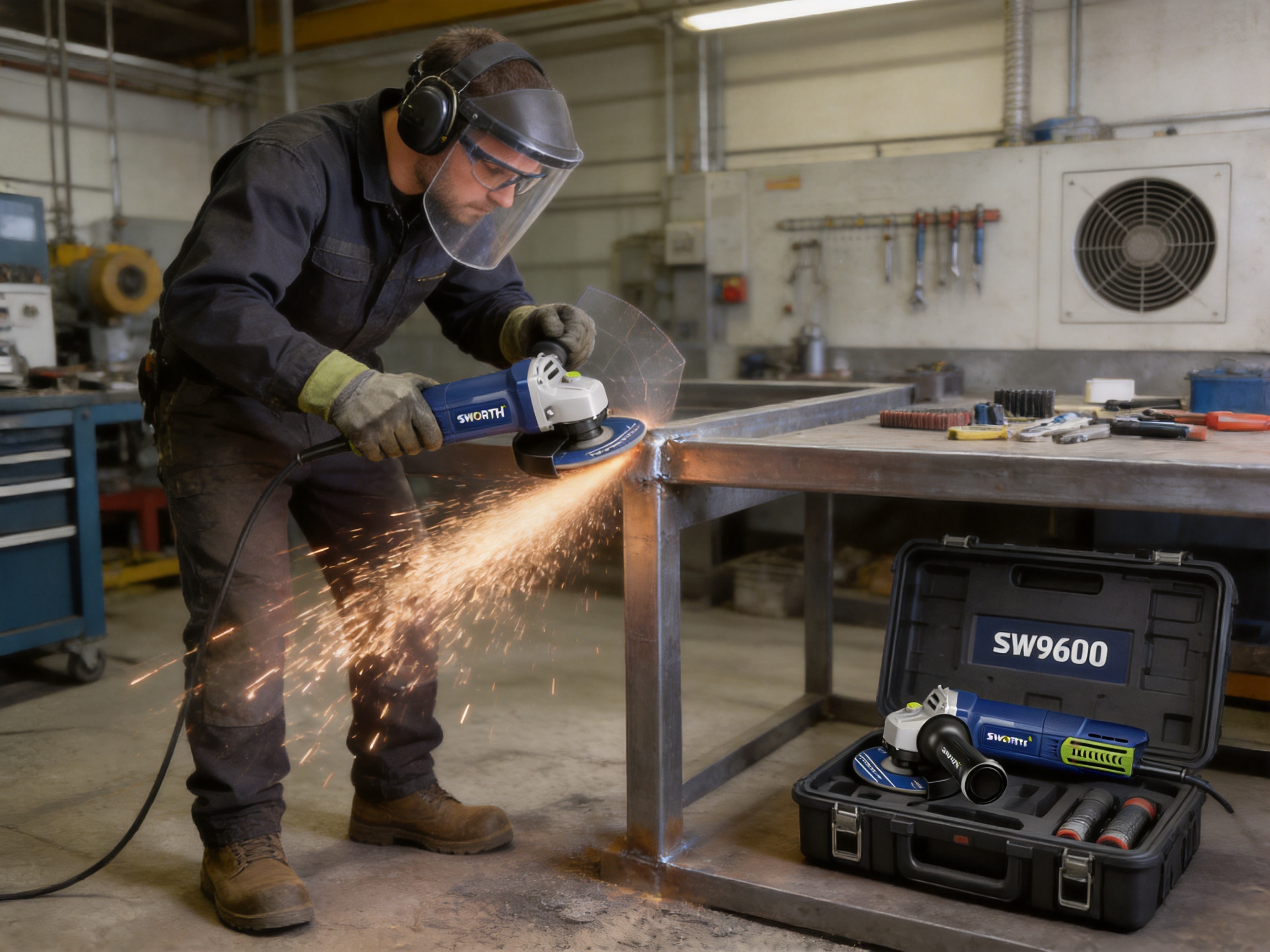
Grinding and cutting can produce sparks, fragments, dust, and high noise levels. Operators should wear suitable eye and face protection, hearing protection, gloves appropriate to the task, protective clothing, and respiratory protection where required by the material and workplace risk assessment.
The workpiece should be securely supported, and bystanders should remain outside the potential path of sparks and fragments. The operator should maintain a stable stance and keep both hands on the tool when the application requires two-handed control.
Maintenance and Service Considerations
Carbon Brush Inspection
Carbon brushes are consumable components and should be inspected periodically. Signs of brush wear may include reduced power, intermittent operation, unusual sparking, or difficulty starting. Replacement should be performed using compatible parts and appropriate service procedures.
Because the SW9600 uses extended 6 × 11 mm brushes, the service interval may be longer than that of a grinder with smaller brushes. Actual life depends on workload, operating duration, material dust, supply conditions, and user technique.
Gear and Spindle Care
The gear housing should be checked if the grinder develops unusual noise, excessive vibration, or visible leakage. Gear lubrication must be maintained according to the manufacturer’s service guidance. Unauthorized disassembly can affect alignment and may create safety risks, so complex repairs should be handled by qualified service personnel.
Electrical Inspection
The power cord, plug, switch, and housing should be inspected regularly. A damaged cord or cracked housing should be repaired or replaced before further use. Electrical maintenance should be carried out by qualified personnel who understand the relevant safety requirements.
Storage
The grinder should be stored in a dry, clean location away from excessive moisture, corrosive chemicals, and extreme temperatures. Accessories should be removed or stored securely to prevent damage to the tool and other equipment. For fleet users, recording inspection dates and service history can improve maintenance planning.
Purchasing Considerations for Distributors and Project Buyers
When purchasing angle grinders in volume, buyers should evaluate more than the rated wattage. Important considerations include motor construction, gear durability, brush accessibility, electrical compatibility, branding method, quality control, packaging, replacement parts, and supplier communication.
The SW9600 offers a practical combination for buyers seeking a professional-oriented product with permanent branding. The laser engraving is suitable for private-label programs and managed tool fleets. The motor reinforcement and mechanical construction support a positioning above basic consumer-grade grinders. The company’s integrated development and production capabilities can also support communication about product configuration and commercial requirements.
Buyers should confirm regional requirements before placing an order, including voltage, frequency, plug configuration, labeling, packaging language, accessory standards, and applicable safety certifications. Sample evaluation is recommended for large orders. Testing should include no-load operation, practical grinding or cutting performance, vibration, sound, temperature behavior, brush access, and the durability of the engraved marking.
For distributors, consistent product presentation is another consideration. A permanent logo can help create a recognizable product range, while stable specifications support catalog accuracy and customer confidence. For contractors, the focus may be on service life, downtime reduction, tool identification, and suitability for daily work.
Company Manufacturing and Development Capabilities
The manufacturer has experience producing professional tools for construction, demolition, chiseling, cutting, and related applications. This background is relevant to angle grinder development because many of the same engineering priorities apply across these categories: impact resistance, motor durability, heat management, ergonomic handling, and dependable operation in harsh environments.
The company follows a “Focus on Professionalism, Quality First” approach. Its manufacturing activities are supported by research and development, production, and sales functions. This structure allows the business to serve both standard product requirements and the needs of customers seeking reliable tools for professional engineering projects.
The company has also developed expertise in brushless motors, electronic controls, and intelligent battery platforms for green garden equipment. Although the SW9600 is a corded angle grinder, knowledge in these areas demonstrates broader capability in motor design, power management, control systems, and battery-driven tool development.
A supplier with experience across demolition tools, cutting tools, corded power tools, and cordless garden equipment can bring cross-category knowledge to product improvement. For example, lessons from vibration control, thermal design, housing strength, and motor efficiency may be applied to different product families.
For international buyers, supplier reliability includes more than production capacity. It also involves communication, technical documentation, quality consistency, packaging coordination, order management, and after-sales support. An established manufacturer with integrated operations is better positioned to coordinate these requirements than a company focused solely on trading finished products.
Why the SW9600 Is a Practical Professional Choice
The SW9600 stands out because its advantages are distributed across the complete tool rather than concentrated in one specification. Its 1150W input provides useful working power, but the reinforced electrical and mechanical details are equally important. The high-temperature copper wire supports heat tolerance, the 63H motor design supports overload capacity, and the enlarged commutator and extended brushes support service durability.
The double tight-fit gears are designed for smooth power transfer, while the integrated head shell and gear housing provide a stronger front-end structure. Together, these features address common points of concern in angle grinders: motor fatigue, brush wear, gear noise, transmission instability, and housing durability.
The permanent laser-engraved logo adds a commercial and organizational advantage. It helps businesses protect tool identity, support fleet management, and present a more professional appearance over the equipment’s service life. This is especially relevant for private-label customers, rental companies, contractors, and distributors.
Compared with a basic angle grinder designed only for occasional use, the SW9600 offers a more complete professional proposition. It is intended for users who need a dependable tool for repeated grinding, cutting, rust removal, and weld-finishing tasks while also valuing maintainability and long-term identification.
Frequently Asked Questions
What type of tool is the SW9600?
The SW9600 is a corded angle grinder with a 1150W power input and a 100 mm blade size. It is intended for grinding, cutting, rust removal, weld smoothing, and general metalworking and construction applications.
What voltage does the grinder use?
The rated voltage is 220–240V~, with a rated frequency of 50/60Hz. Buyers should confirm that the local electrical supply and plug configuration are compatible before use.
What is the advantage of the laser-engraved logo?
The laser-engraved logo is designed to remain visible without peeling or fading like many adhesive labels. It is useful for private-label products, contractor fleets, rental equipment, and workplace tool identification.
Does the laser engraving affect tool performance?
The engraving is a branding and identification feature on the tool body. The grinder’s operating performance comes from its motor, electrical components, gear system, spindle assembly, housing, and accessory compatibility.
Why is the enlarged commutator important?
The 24.5 mm enlarged and heightened commutator supports the electrical contact between the rotor and carbon brushes. Consistent contact is important for stable motor operation and durability during repeated use.
How do the extended carbon brushes help?
The 6 × 11 mm extended carbon brushes provide more usable wear material than smaller brush arrangements may offer. This can support longer service intervals, although actual brush life depends on workload, dust, operating time, and maintenance.
What does the 200°C copper wire specification mean?
The motor uses copper wire with high-temperature capability up to 200°C. This supports the motor’s ability to tolerate heat generated during demanding operation. It does not mean the grinder should be intentionally overheated or operated without adequate ventilation.
What are double tight-fit gears?
Double tight-fit gears are designed to maintain close engagement between the gear components. The objective is smoother power transmission, reduced unwanted movement, and improved reliability under working resistance.
Can the grinder be used continuously?
The grinder is designed for professional and demanding applications, but continuous operation should follow correct working practices. Operators should use suitable accessories, avoid excessive pressure, keep ventilation openings clear, and allow the tool to cool when required.
What materials can it work on?
The grinder is primarily suited to compatible metalworking and construction tasks, including rust removal, weld smoothing, surface preparation, and suitable metal cutting or grinding. The correct disc must be selected for the material and operation.
Is it suitable for rental fleets?
Yes. The permanent laser-engraved identification, reinforced construction, extended brushes, and professional-oriented motor system make it suitable for contractors and rental companies that need identifiable equipment for repeated use.
What should buyers test before placing a large order?
Buyers should evaluate power behavior, vibration, sound, temperature, gear operation, brush access, housing quality, accessory compatibility, electrical configuration, packaging, and the durability of the laser engraving. A sample or pilot order is recommended for commercial programs.
Does the manufacturer support customized branding?
The product is equipped with laser-engraved branding on the body. Buyers should discuss logo artwork, placement, minimum order quantities, packaging, color requirements, documentation, and production approvals with the supplier before confirming a customized order.
Conclusion
The SW9600 angle grinder is designed for professional users who require dependable performance, durable internal construction, and long-term tool identification. Its 1150W motor system, 200°C high-temperature copper wire, 63H motor design, enlarged 24.5 mm commutator, extended 6 × 11 mm carbon brushes, double tight-fit gears, and integrated head shell and gear housing create a balanced platform for demanding grinding and cutting work.
Its permanent laser-engraved logo provides a clear advantage over conventional sticker-based branding. For contractors, workshops, rental fleets, and distributors, the engraving improves identification and preserves product presentation throughout the tool’s working life.
The manufacturer’s integrated research, production, and sales capabilities, together with its experience in demolition tools, cutting tools, power systems, and brushless motor technology, provide a strong foundation for professional tool development. Through material selection, controlled assembly, product testing, and attention to practical job-site requirements, the company is positioned to serve buyers seeking reliable equipment for construction, fabrication, maintenance, and engineering applications.
For users comparing compact angle grinders, the SW9600 offers a combination of power, thermal resistance, serviceability, mechanical durability, and permanent branding that makes it a practical choice for repeated professional work.
References
1. Manufacturer-provided SW9600 product specifications and feature information.
2. Manufacturer-provided company profile and manufacturing capability statement.
3. General principles of electric motor construction, commutator operation, and carbon brush maintenance.
4. General workshop practices for abrasive wheel selection, angle grinder operation, and personal protective equipment.
5. General principles of gear transmission, lubrication, housing design, and power tool preventive maintenance.
Product: SW9600 Angle Grinder with Laserengraving Logo

Recommended Products
-


SW528 Small Hole Rebar Hammer
-
SW932 Groove Sandblasting Hammer
-
SW9362A Large Hole Rebar Hammer
-
SW940 Enlarged Hole Rebar Hammer
-
SW35S1 Powerful Demolition Hammer
-
SW35S2 High-Efficiency Heat Dissipation Demolition Hammer
-
SW9371 High-Power Demolition Hammer
-
SW9373 Anti-Scalding Carbon Brush Holder Demolition Hammer
-
SW535 Powerful Anti-Scalding Demolition Hammer
-
SW535-2 Durable Powerful Demolition Hammer
-
SW35S3 Five-Pipe Drill Bit Demolition Hammer
-

SW11E Five-Pipe Clamping Demolition Hammer
 +86-18314829275
 sale@sworthtools.com
 No. 101, Yugui Road, chengxi Industrial Zone, Yongkang City, Zhejiang Province, China
Copyright© Yongkang Siwei Technology Co., Ltd. All Rights Reserved

Hammer Tools & Cordless Garden Tools Manufacturer
